
What makes eCash different from Bitcoin?

Updated: 7 hours ago
What makes eCash different from Bitcoin? eCash (ECX) is a copy of Bitcoin that split off on October 29, 2026, at block 973,728. It keeps Bitcoin's history, keys and mining, and changes a short list of rules.
The biggest change is drivechains. These are sidechains that let eCash add new features without changing the base coin.
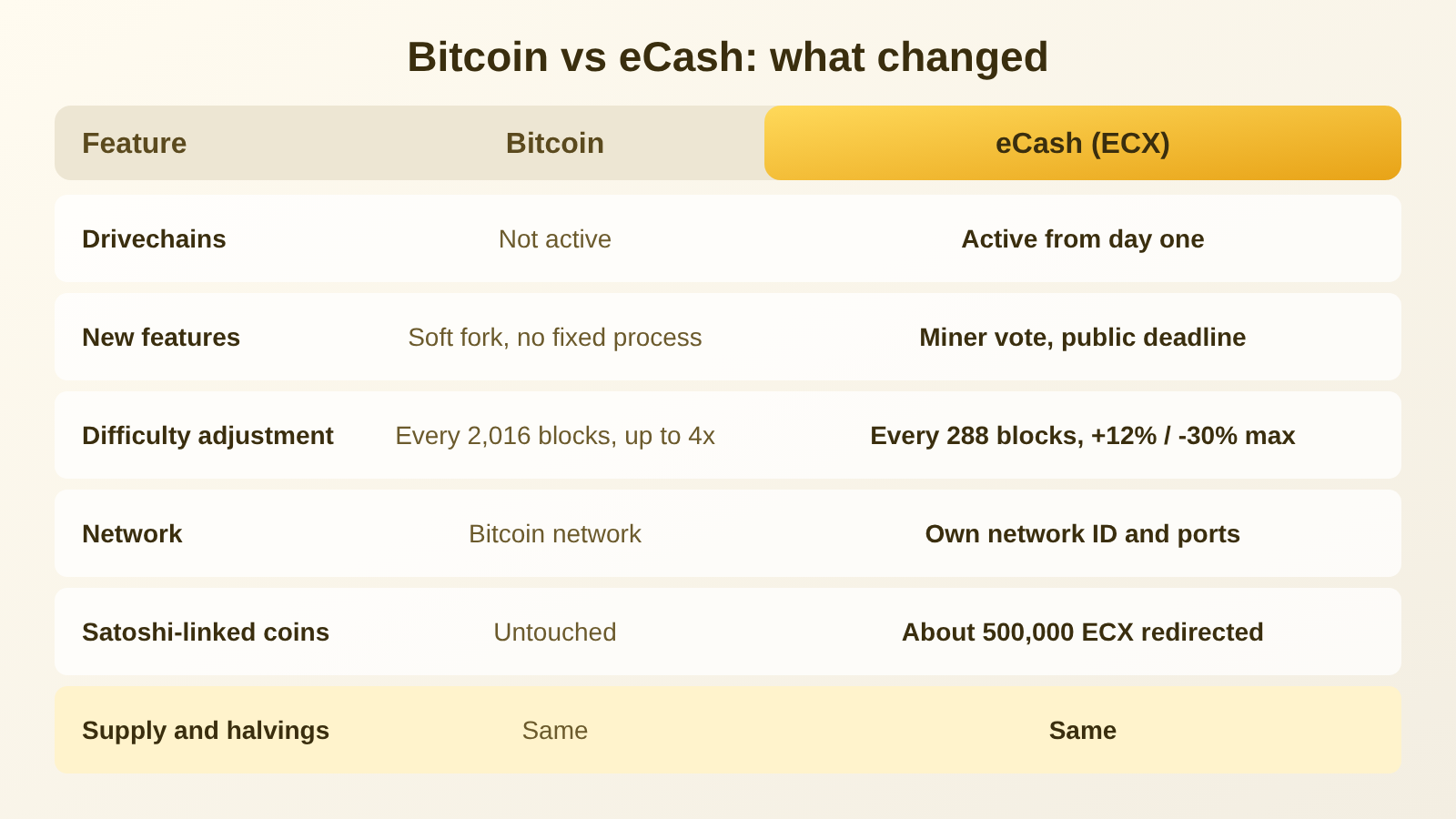
Here is exactly what makes eCash different from Bitcoin, and what stays the same.
What makes eCash different from Bitcoin?
eCash runs the same kind of software as Bitcoin, but with seven key changes:
Drivechains are on. BIP 300 and BIP 301 are active from day one.
New features ship by miner vote. No multi-year soft fork fight.
Drivechains pay miners. Sidechain activity becomes fee income for ECX miners.
A different difficulty rule. It adjusts every 288 blocks instead of every 2,016.
Its own network. Separate ports, a separate network ID and opt-in replay protection.
Part of Satoshi's coins were reassigned. About 500,000 ECX went to investors and development.
A different launch path. ECX launched without a major exchange listing.
Each one is explained below.
What eCash and Bitcoin have in common
Most of eCash is plain Bitcoin. It was built from Bitcoin Core's code, and everything before block 973,728 is shared history.
Same history. Every Bitcoin transaction up to the fork is also part of eCash.
Same addresses and keys. If you held BTC in your own wallet at the fork, you hold the same amount of ECX.
Same mining. eCash uses SHA-256, so any Bitcoin miner can mine it.
Same wallet basics. Addresses, keys and signatures work the way they do on Bitcoin.
Same supply and halvings. The coin cap and the halving schedule are identical on eCash.
Bitcoin itself did not change. Your BTC was not moved, locked or touched by the fork.
1. Drivechains are switched on
A drivechain is a sidechain that uses ECX as its coin. You move ECX in, use features the main chain does not have, then move it back out.
Each drivechain can have its own rules. One can focus on privacy, another on fast payments, another on names or markets.
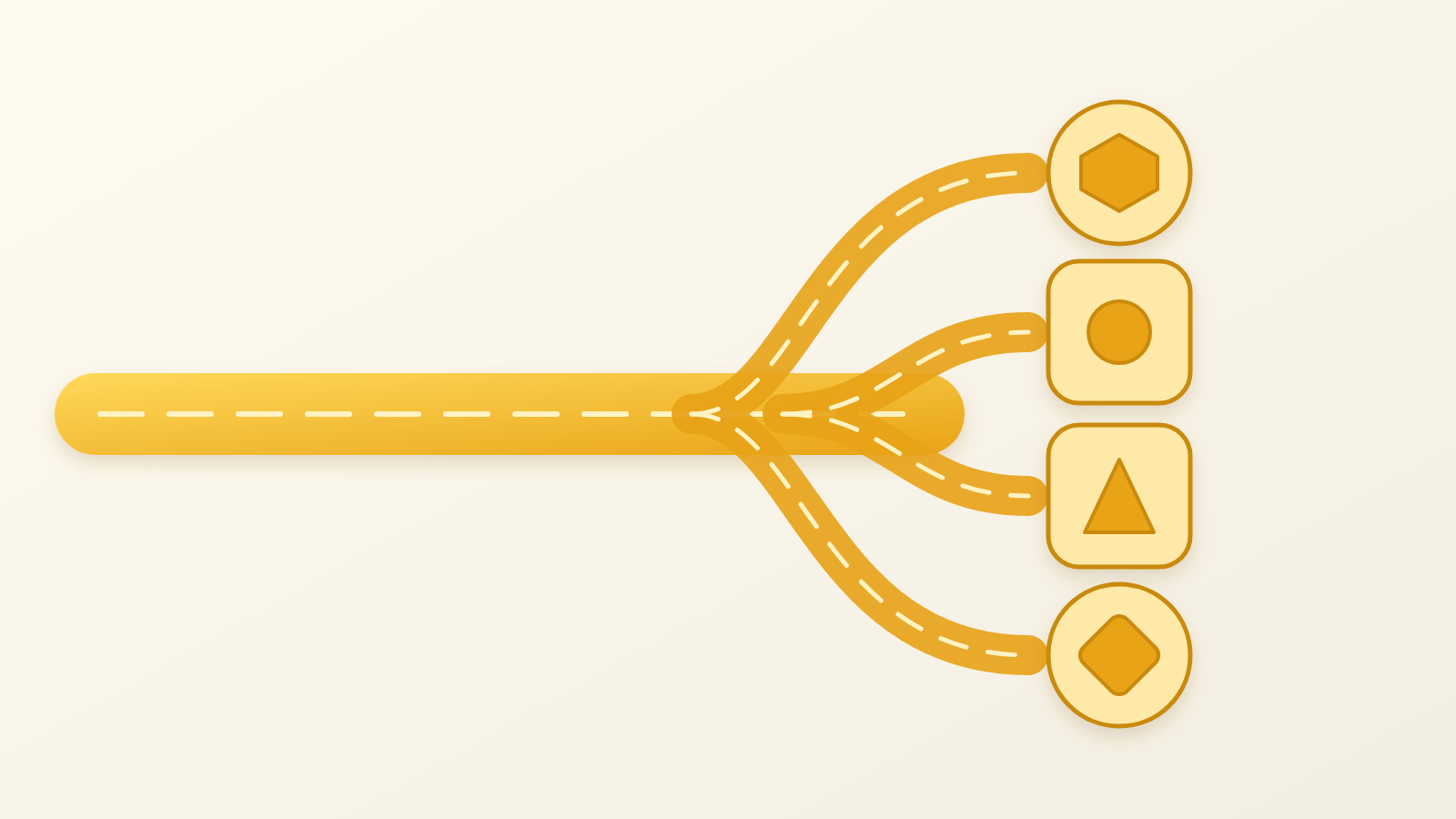
Some examples on eCash:
Thunder: fast, cheap payments.
zSide: private payments in the style of Zcash.
BitNames: names you own, like a decentralized phone book.
Truthcoin: prediction markets. See our Truthcoin guide.
Flush: fast token trading. See what Flush is.
There are 256 slots, so there is room for many more. Our drivechain hub lists them all.
Why Bitcoin never added them
Drivechains were first proposed for Bitcoin as BIP 300 and BIP 301. They never gained enough support to activate there.
Their inventor, Paul Sztorc, chose a hard fork instead. He explains why in our Paul Sztorc interview.
How money leaves a drivechain
Moving ECX out of a drivechain is slow on purpose. Miners must approve each batch of withdrawals in public.
On eCash, a batch needs votes in more than 6,048 of 12,096 blocks. That makes theft slow and visible, so users have time to react.
2. New features need a miner vote, not years of debate
Bitcoin changes its rules through soft forks. There is no fixed rule for how much support one needs, and the last big one, Taproot, activated in 2021.
eCash sets a clear process for new drivechains. A chain is proposed into an empty slot, and miners vote for it in the blocks they mine.
On eCash mainnet, a new chain needs votes in more than 1,815 of 2,016 blocks. If it gets them, it activates. If not, the proposal expires.
People who never use a drivechain are not affected by it. That is why adding one does not need the whole network to agree.
3. Drivechains pay eCash miners
Bitcoin pays miners with new coins and transaction fees. The new coins halve about every four years, so fees have to grow over time.
eCash adds a third source of income. Drivechain blocks are secured through blind merged mining, or BMM.
Each drivechain block producer pays ECX miners a fee to include its block. So a private payment, a name purchase and a market trade can all pay the same miners.
The goal is a chain whose security is paid for by use, long after the new coins run low.
4. eCash uses a different difficulty adjustment
Difficulty controls how hard it is to mine a block. It keeps blocks coming about every 10 minutes as miners join and leave.
Bitcoin adjusts every 2,016 blocks, about two weeks. Each step can raise difficulty up to 4 times or cut it to a quarter.
eCash changed this rule four days before launch. It now adjusts every 288 blocks, and each step is damped to one seventh.
Bitcoin: every 2,016 blocks, up to 4x up or down.
eCash: every 288 blocks, up 12% or down 30% at most.
The new rule also fixes an old off-by-one error in Bitcoin's math. That error is behind the timewarp attack.
The trade-off is speed of recovery. If hashrate drops fast, blocks can stay slow for a while, because each cut is capped.
Our eCash difficulty adjustment explainer covers the rule, the reasons behind it and how it has played out since launch.
5. eCash runs its own network
eCash nodes use their own network ID and ports. That keeps them from connecting to Bitcoin nodes by mistake.
Replay protection is opt-in. eCash wallets add a marker to each transaction that makes it invalid on Bitcoin.
A transaction sent without that marker can be copied onto the other chain. If you hold both coins, split them before you spend. Our guide on how to split BTC and ECX walks through it.
6. Some of Satoshi's coins were reassigned
This is the most debated difference. About 1.1 million coins sit in early addresses widely linked to Satoshi Nakamoto.
On a normal fork, those addresses would get 1.1 million ECX. eCash leaves about 600,000 ECX there and redirects about 500,000 ECX to early investors and development funding.
Supporters say it funds the project without an ICO. Critics call it a dangerous precedent for dormant coins.
Either way, no BTC moved. The change exists only on the eCash chain.
7. How you get eCash
Bitcoin trades on almost every exchange. ECX launched without a major exchange listing.
Before launch, Sztorc said several exchanges asked for listing fees of $100,000 to $200,000. He declined, saying someone would likely list ECX for free soon.
For now, the main routes are a bridge to a wrapped token on Solana and swap services. Our guide on how to buy eCash ECX covers each route and its risks.
One warning: price sites that show "eCash" usually mean XEC, a different coin. See ECX vs XEC before you buy anything.
eCash vs Bitcoin: quick answers
Is eCash the same as Bitcoin?
No. eCash shares Bitcoin's history and mining, but it is a separate coin on a separate network since block 973,728.
Do I own eCash if I own Bitcoin?
If you held BTC in your own wallet at block 973,728, yes, one ECX per BTC. If your BTC was on an exchange, it depends on that exchange. Our eCash airdrop guide explains how to check.
Is eCash faster than Bitcoin?
Not on the main chain. Both aim for one block about every 10 minutes. Speed on eCash comes from drivechains like Thunder and Flush.
Who created eCash?
Paul Sztorc and his company, LayerTwo Labs. Sztorc wrote the original drivechain proposals for Bitcoin.
Does eCash change Bitcoin?
No. eCash is its own chain. Bitcoin's rules, coins and network are exactly as they were.
Still deciding what you think?
The differences that matter are the ones that change after launch, not the ones in a comparison table.
We send one short email a week, only when something real happens. A chain goes live, a rule changes, a scam starts going around. No price talk.


Comments